
The Old Draw Bridge
Photo Credit, SC Highway Department

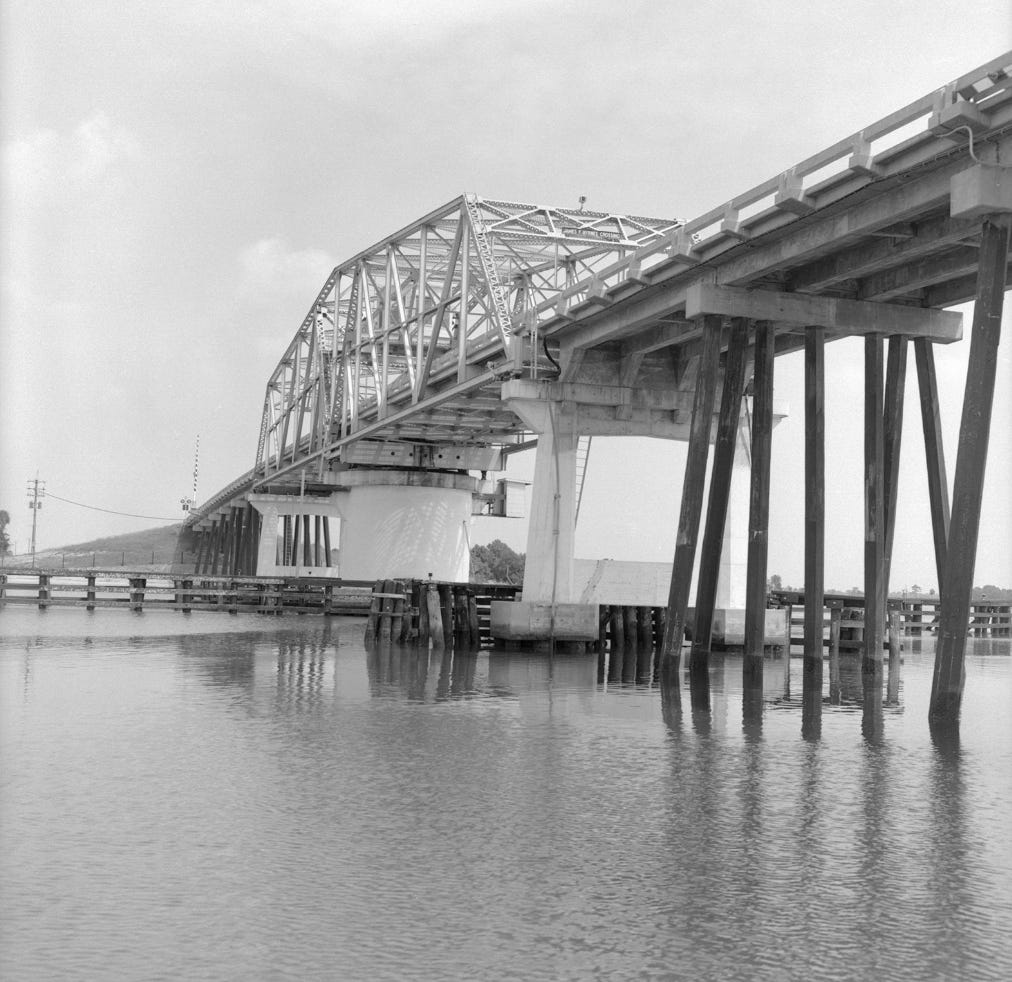
The Old Draw Bridge
There was a time when Hilton Head was in the middle of no-damn-where. It was not on the road to anywhere and the ride was through a country name ‘low’ because it is. In the 70’s South Carolina was a two-lane country-road state, except for I-26 between the two power centers, Charleston, the former Capital and Columbia, the current Capital. Interstate 85 in the Western part of the state linked a string of metropolitan areas From Virginia to Alabama. Highways 17 and 301 were considered major roads but were pretty much just 2-lane streams of Northerners headed to Florida and back in one quick hurry. Hilton Head was way down at the bottom of the state, figuratively and literally, far from the big roads and metropolitan areas.
The first bridge to the island was a steel swing bridge. From 1956 to `982 It rotated 90 degrees to let big boats go by. The boats had the priority and it took a while to move all that steel. If you were going over the bridge you had to figure an extra 30 minutes in case you caught as it was just beginning to open. ‘Islanders’ would assess the position of the span, if it was just opening we would get out and roam up and down the line checking out who was going where and why. It was a social occasion.
Everybody knew everybody or about everybody because there was only about 3,000 people on the island in the early 70’s. The racial split was about 50/50. That made for two small communities who interacted regularly. The only full-service grocery store, the Red and White was a social experience too. The owner, Gene Martin, his wife kids and employees knew everyone and everything. The various black neighborhoods had other smaller stores. We all worked together, shopped together and often socialized together. We also looked out for each other; we had to, there was no one else on our side of Skull Creek.
The bridge was a huge phycological divider. Hilton Head was new, bustling, and growing. Bluffton, and Beaufort were old, established, traditional, historic, and somewhat isolated from the social and commercial revolution going on in the 70’s. We ‘upstarts’ on our side of the bridge were often seen as a nuisance. Hilton Head was known in the New York press as, “Millionaire’s Playground” in the early 70’s. Beaufort was having none of it, except for the power players, the lawyers, that is, the ‘Good-ol’ Boys’ who had the inside track on local and state government, they could see there was money to be made, influence to be peddled and garnered.
For the rest of us there were logistics to work out. Savannah has a real shopping mall where we could buy clothes and shoes and a commercial airport. The drive over was one hour to one hour and 30 minutes depending on you know what.
On March 27th, in the year of our Lord, 19 and 74, a huge barge hit the bridge and knocked it out of commission for a long month right at the start of the spring golf and spring-break season. Three hotels, numerous rental houses, and villas (Hilton Head speak for condominiums), restaurants, golf courses, and The Red and White depended on that traffic. The King of Hilton Head, Charles Fraser, jumped into action, as he always did. He marshalled all his employees to move all those visitors (Hilton Head talk for tourist) into their respective accommodations and all around the island to those restaurants, golf courses, and the Red and White. He called in tour boats from Savanna, marshalled gangs of employees to unload the visitors cars and all their belongings on the old ferry docks, still standing form the days before the swing bridge. We unloaded the car, tagged their belongings, gave them the stubs, loaded them and their stuff on a boat, parked their car in Hog Bluff Plantation (recently converted to Moss Creek). The ferry landing on the Island had its own gangs of employees unloading the visitors and all their stuff, putting it all in company cars and spare personal cars, now acting as free taxies at Charles’s direction. Those cars were not only to get you to your accommodations but to be flagged down at any time for any transportation need. One of my jobs was to make signs for the windows of all the free taxies. For one amazing week, these brigades of men and women shuffled tons of beach floats, dogs, and a huge variety of luggage back and forth. Some people, showed up with paper grocery bags packed with their clothes, shoes, kid’s toys, and groceries. It was chaos for the first few days. Charles Fraser also hired shrimp boats to haul food, and other supplies for the grocery store, the inns, and restaurants. Big trucks brought in whole sides of beef and boxes of canned goods. Shrimp boats, tourist boats, cars lined up for blocks, grocery bags of clothes, dogs, kids, employees, and a tide going up and down 7 ½ feet twice a day on an old ferry dock that had a country sign saying, “Not Fit For Vehicular Traffic” was wild. Dean Poucher was assigned by Charles’s able brother, Joe, as Captain of the wharf on the mainland. He moved the shrimp boats and trucks to the Bluffton Town dock with the help of the highway patrol. After about a week, on April 3rd, the army showed up with a one lane pontoon bridge to span Skull Creek. It was a thrilling ride. The weight of your car pushed each boat down sequentially causing your car to bob up and down as you crossed about 400 yards of open water. You could not see the sides of the Army bridge, only water. You only reference was straight ahead. It was disconcerting . My brave wife, Judy, was the first person to drive a civilian car over the pontoons. She had on a lifejacket and my daughters riding helmet. Ceil Edwards had agreed to go to Savannah with her. When Judy began to gear up for the crossing Ceil asked the obvious question: “where is my life jacket and helmet”. Judy pulled a pool float out of the back seat. Ceil clung to it as they bobbed over the waters in a 3,000-pound Dodge steel-coffin. After escaping death they had a great time shopping in Savannah.
The Army pulled their pontoon bridge to the side of the creek once or twice daily to let the boats go by.
The bridge was built at the shortest distance over the water. Sounds logical enough but it is also in a curve in the waterway and to make it more fun that is the spot where the tide usually splits or converges as it ebbs and flows around the island twice each day. The currents therefore go in opposite directions. Steering a boat into a current with a 40-foot barge in front has got to be challenging.
I can’t remember how long we used the pontoon bridge. The State eventually got the old swing bridge working. In 1982 it was replaced by the concrete monster that spans the Intracoastal waterway, aka, Skull Creek and will soon to be replaced with another even large and more impersonal monster to accommodate the ever-growing hordes spurred on by the Chamber of commerce and the City leaders, who never knew the joys of socializing in the Red and White and at the feet of the old Jimmy Byrnes bridge. Byrnes was from South Carolina and help Harry Truman win the Second World War as Secretary of State and was Truman’s close advisor. The current bridge is named after a former Commissioner of the South Carolina Highway Department, local farmer, and owner of the first motel on the Island, Wilton Graves. They are all lost in a distant but noble past, as is the old swing bridge and much of the memories of a natural island that allowed us to blend in with its sumptuous natural beauty. We must remember why the tourist/visitors come. It sure isn’t the man-made part of the Hilton Head Island experience, especially the traffic! Oh for the good ol’ days.
Great story. I'm still laughing at Judy driving on the pontoon bridge with a bike helmet on! And tossing her friend a pool noodle--Good Lord they were brave!